

Table of Contents
- What to Expect at Pokemon Card Shops
- Best Place to Buy Pokemon Singles
- How to Spot Fake Pokemon Cards
- Sealed Products vs. Singles: Which Should You Buy
- Finding Grading-Ready Cards at Local Retailers
- Gaming Events and Community at Pokemon Card Shops
- How to Verify Authorized Wholesale Sources
- Frequently Asked Questions
Last Updated: September 30, 2026
What to Expect at Pokemon Card Shops
Walking into a Pokemon card shop for the first time can feel overwhelming. You'll encounter rows of booster boxes, display cases filled with graded cards, and collectors hunched over binders examining singles. But knowing what to expect at Pokemon card shops transforms the experience from confusing to exciting.
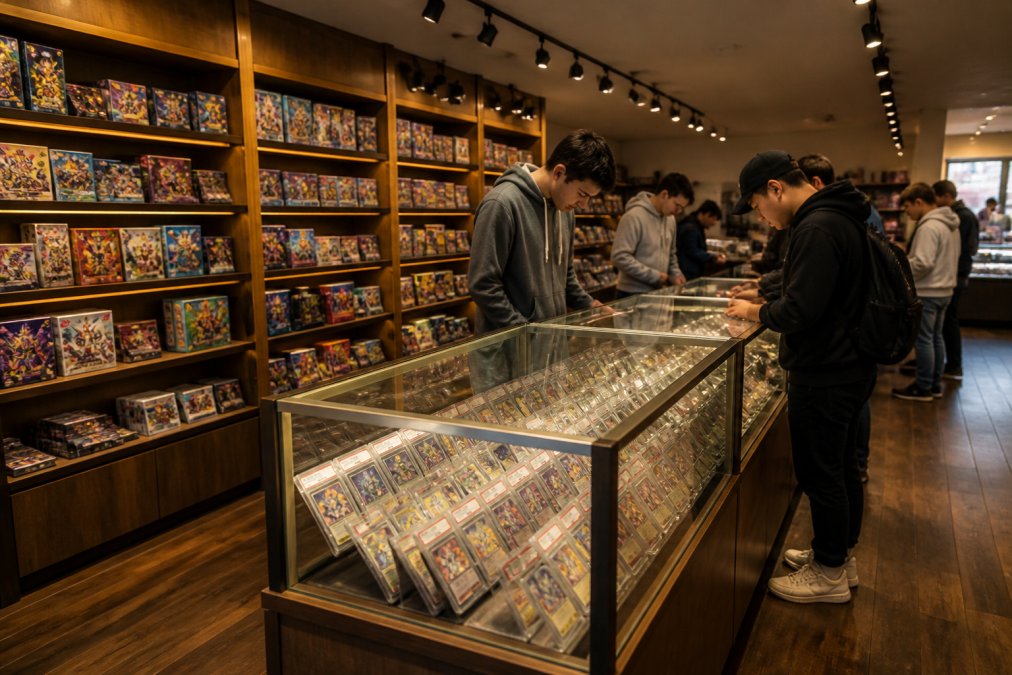
Most Pokemon card shops operate as community hubs, not just retail counters. The atmosphere varies by location, some shops emphasize competitive play, others focus on casual collecting and investment-grade cards.
At Liberty TCG, every card in our inventory is hand-checked before listing, and we source through authorized wholesale channels to guarantee authenticity. Whether you shop for sealed products or specific singles, you're working with someone who collects too.
The typical Pokemon card shop stocks several product categories. You'll find booster packs, elite trainer boxes, and sealed booster boxes for opening. Singles are usually organized by set, rarity, and condition. Graded cards, those authenticated and encased by professional grading companies, occupy premium display space because of their higher value.
![30th Celebration Elite Trainer Box [30C]](https://cdn.shopify.com/s/files/1/1004/1907/6392/files/704143.jpg?v=1789579464)
Best Place to Buy Pokemon Singles
The best place to buy Pokemon singles depends on what you're hunting and how much you value convenience. Singles represent the most targeted way to build your collection, you get exactly the card you want instead of hoping for it in a pack.
Online retailers and local shops each offer distinct advantages. Online options provide access to broader inventory and competitive pricing. Local retailers offer the ability to inspect cards before purchase and avoid shipping damage. The real differentiator isn't location, it's whether the retailer hand-checks cards and sources from authorized wholesale channels.
When evaluating where to buy singles, look for these markers of reliability:
- Hand-checked inventory with documented condition ratings
- Authorized wholesale sourcing (not gray market or questionable origins)
- Clear return policies for cards that arrive damaged or misrepresented
- Transparent pricing that doesn't inflate based on hype
- Staff who can discuss card condition, rarity tiers, and market trends
Liberty TCG specializes in singles sourced through authorized wholesale partners. We photograph each card's condition before listing, and our hand-checking process catches manufacturing defects or wear that might affect grading potential. For collectors building investment portfolios, this verification step matters enormously.
The pricing you find varies significantly based on card rarity, condition, and current market demand. Rare cards in mint condition command premium prices. Common cards and those with visible wear cost substantially less.
How to Spot Fake Pokemon Cards
Counterfeit Pokemon cards circulate in the collectible market, making authentication skills essential for serious collectors. Knowing how to spot fake Pokemon cards protects your investment and prevents wasted money on worthless counterfeits.
Authentic cards have specific physical characteristics that counterfeiters struggle to replicate consistently. The cardstock itself feels different, genuine Pokemon cards use premium cardboard with a particular weight and texture. Fakes often feel flimsy or waxy by comparison.
Examine these details on any card you're considering:
- Print quality: Authentic cards have crisp, clean printing with precise color registration. Fakes often show blurry text, misaligned colors, or uneven ink coverage.
- Holo pattern: The holographic layer on rare cards should display a specific, consistent pattern. Counterfeits often use generic holo that doesn't match the official design.
- Text and borders: Look closely at the card text and borders. Official cards maintain perfect alignment and consistent font weight. Fakes frequently show slightly off text or uneven borders.
- Back of card: The back should match official specifications exactly. Fakes sometimes get the back pattern wrong or use incorrect colors.
- Weight and feel: Hold the card. Genuine Pokemon cards have a specific weight and flexibility. Counterfeits often feel too light or too stiff.
The most reliable way to verify authenticity is professional grading. Services like PSA, BGS, and CGC authenticate cards and assign grades based on condition.
When buying from retailers, ask about their authentication process. Do they hand-check cards? Do they guarantee authenticity? What happens if you discover a card is counterfeit after purchase? These questions reveal whether a seller actually verifies what they're selling.
Sealed Products vs. Singles: Which Should You Buy
Choosing between sealed products and singles shapes your entire collecting strategy. Each approach serves different goals, and many collectors use both.
Sealed products, booster boxes, elite trainer boxes, and bundle packs, contain randomized cards you haven't seen. The appeal is the hunt: you might pull rare cards worth far more than the box cost. The downside is predictability. Most sealed products return less value than their purchase price when you calculate the actual cards inside.
Singles let you build exactly what you want. You choose specific cards, specific conditions, and specific rarity levels. This approach costs more upfront per card but guarantees you get what you're after. For collectors building specific decks or investment portfolios, singles are essential.
30th Celebration Elite Trainer Box [30C] →
| Approach | Best For | Cost Model | Time Investment |
|---|---|---|---|
| Sealed Products | Casual opening, the thrill of pulls, building bulk inventory | Higher per-card cost, but bundled pricing | Low, open and enjoy |
| Singles | Targeted collection, investment portfolios, specific deck building | Lower per-card cost for common cards, premium for rare | High, research and selection |
New collectors often start with sealed products because the experience feels more exciting. You're opening packs, hoping for hits, experiencing the anticipation. This is perfectly valid. But if you want specific cards for a deck or portfolio, singles are more efficient.
Liberty TCG stocks both sealed products and singles, priced competitively through authorized wholesale sourcing. Our elite trainer boxes like the 30th Celebration Elite Trainer Box at $145.00 include 9 booster packs plus accessories for serious collectors. For singles hunters, our hand-checked inventory ensures condition matches the listing.
The hybrid approach works best for many collectors: buy sealed products for enjoyment and the chance at valuable pulls, buy singles to fill gaps in your collection. This balances excitement with strategy.
Finding Grading-Ready Cards at Local Retailers
Grading-ready cards command premium prices because they're authenticated and condition-verified. Finding grading-ready cards at retailers requires understanding what "grading-ready" actually means and how to evaluate condition yourself.
A grading-ready card is one that could potentially receive a high grade from professional services like PSA or BGS. This doesn't mean it will definitely grade high, condition assessment involves subjectivity. But it means the card shows no obvious defects: no creases, stains, or heavy wear.
When shopping for grading-ready cards, examine these condition factors:
- Centering: Is the image centered within the borders, or does it shift toward one edge?
- Corners: Are corners sharp or rounded from handling?
- Edges: Do edges show wear, whitening, or fraying?
- Surface: Is the card surface clean, or does it show scratches or dents?
- Color: Is the color vibrant or faded?
Retailers who hand-check inventory can identify these details and price accordingly. A card with perfect centering and sharp corners costs more than one with minor centering issues. This pricing reflects grading potential.
At Liberty TCG, we photograph cards under consistent lighting to show condition clearly.
Gaming Events and Community at Pokemon Card Shops
The gaming community around Pokemon card shops creates value beyond the products themselves.
The community aspect matters more than many collectors realize.
How to Verify Authorized Wholesale Sources
The difference between authentic cards and counterfeits often traces back to sourcing. Verifying that a retailer sources from authorized wholesale channels protects you from unknowingly buying counterfeits mixed into inventory.
When evaluating a retailer's sourcing, ask these questions directly:
- Do you source from authorized distributors?
- Can you provide documentation of your wholesale partnerships?
- What's your authentication process for incoming inventory?
- If a customer discovers a counterfeit, what's your response?
- Do you guarantee authenticity on all products?
Frequently Asked Questions
Where can I find reputable Pokemon card shops near me?
Pokemon card shops in your area typically specialize in trading card games and collectible card game inventory. Look for retailers that source from authorized wholesale channels, hand-check their inventory, and offer both sealed products and singles. Ask about their sourcing practices and request to see their authentication process before making large purchases.
What's the best place to buy Pokemon singles?
The best place to buy Pokemon singles depends on your priorities. Online retailers provide broader inventory and competitive pricing. When choosing any retailer, verify they source through authorized wholesale channels, hand-check cards for condition and authenticity, and offer clear return policies. Whether shopping locally or online, prioritize sellers who are transparent about their card sourcing and grading standards.
How can I verify the authenticity of Pokemon cards before buying?
Authentic Pokemon cards have specific characteristics: sharp, clean printing with no blurring, correct font weight and spacing, proper card stock weight and texture, and accurate color saturation. Examine the holo pattern for consistent texture and alignment. Check the card edges for clean cuts and consistent borders. Reputable retailers hand-check every card and source from authorized wholesale channels, which significantly reduces counterfeit risk. Ask the shop about their authentication process and whether cards are grading-ready before purchase.
What's the difference between buying sealed products and singles?
Sealed products (booster boxes, elite trainer boxes, and blister packs) contain random cards and offer the thrill of opening packs and the chance to pull rare cards. Singles let you target specific cards for your collection or deck-building needs. Sealed products are often priced below market value at authorized retailers, making them good for collectors who enjoy the opening experience. Singles are ideal if you need particular cards for play or collection completion. Both options should come from retailers sourcing through authorized wholesale channels to ensure authenticity.