

Table of Contents
- Understanding Resealed Pokémon Booster Packs
- How to Spot Fake Pokémon Cards in Resealed Packs
- Examining the Physical Seal and Packaging
- Signs of Tampering on Booster Boxes
- Comparing Suspicious Packs to Verified Authentic Packs
- Weight Variance and Card Shifting Tests
- What to Do If You Receive a Resealed Pack
- Conclusion
- Frequently Asked Questions
Last Updated: September 21, 2026
Understanding Resealed Pokémon Booster Packs
Resealed pokemon booster packs are sealed products that have been opened, had cards removed or swapped, and then resealed to look factory-fresh. These counterfeit packages are a growing problem in the TCG market, and collectors need to know how to spot them.
How to Spot Fake Pokémon Cards in Resealed Packs
Resealed packs contain cards with visible quality issues. Counterfeiters lack access to The Pokémon Company's exact printing equipment, creating detectable differences that require systematic inspection.
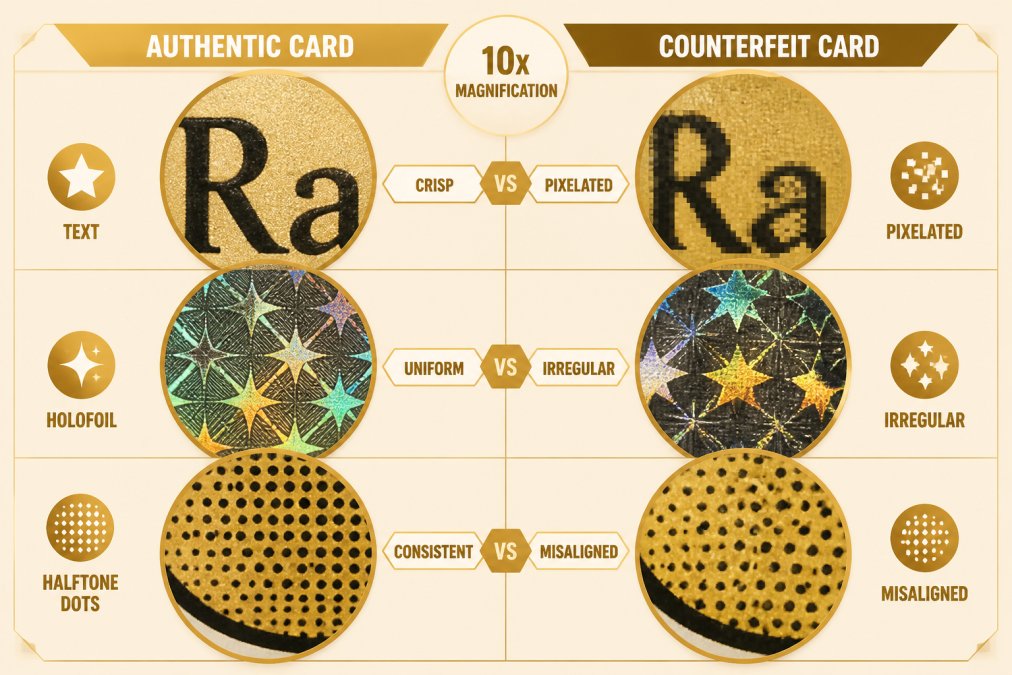
Print Quality and Color Saturation
Authentic Pokémon cards have sharp, vibrant colors with ink flush against the card stock. Fakes look dull or washed out.
- Color depth: Real cards show rich, saturated colors with uniform, smooth ink. Fakes show uneven saturation, visible dots, or color bleeding.
- Text clarity: Real text has crisp edges and uniform line weight. Counterfeits show pixelation, fuzzy edges, or inconsistent thickness.
- Holofoil pattern: Should be uniform and smooth. Counterfeits have uneven, misaligned, or interrupted patterns.
- Border alignment: Borders should be even. Misaligned borders signal counterfeits.
- Dot pattern: Real cards use regular, consistent halftoning. Counterfeits show irregular or oversized dots.
Card Stock and Texture Inconsistencies
Real Pokémon cards have specific measurable properties and a smooth, slightly textured feel. Counterfeits feel and measure differently.
- Card weight and thickness: Real booster pack cards weigh 1.8-2.0 grams and measure 0.30-0.35 mm thick. Significant deviations indicate counterfeits.
- Surface texture: Real cards have a consistent matte finish. Counterfeits feel glossy, rough, or grainy.
- Card edges: Should be clean and sharp with consistent color. Rough or discolored edges indicate counterfeits.
- Corners: Authentic corners are crisp. Worn or rounded corners suggest counterfeits.
Examining the Physical Seal and Packaging
The packaging itself tells a story. Factory seals are applied with precision. Resealed packs show telltale signs if you know what to look for.
Factory Shrink Wrap and Crimp Lines
- Crimp lines: Real packs have clean, evenly spaced horizontal and vertical crimp lines. Resealed packs have uneven, wavy, or poorly defined lines.
- Shrink wrap tightness: Authentic packs are wrapped tightly with no gaps. Resealed packs have loose or baggy areas.
- No wrinkles or bubbles: Factory seals are smooth. Wrinkles, bubbles, or creases signal resealing.
- Uniform coverage: Shrink wrap should cover evenly. Patchy coverage is suspicious.
Heat-Sealed Edges and Vertical Seams
Also inspect the cardboard seals:
- Vertical seams: Should be straight and even. Wavy or off-center seams suggest resealing.
- Horizontal seal at top: Should be crisp and clean. Wrinkled or poorly sealed tops indicate resealing.
- Back flap: Should be sealed flush. Loose, bubbled, or separating flaps indicate opening.
- No glue residue: Authentic packs have no visible glue. Glue marks suggest resealing.
Signs of Tampering on Booster Boxes
Booster boxes (36 packs) are common fraud targets. Scammers reseal boxes to hide missing or swapped packs.
Loose or Baggy Packaging
A sealed booster box should feel solid with no shifting packs. Red flags:
- Movement inside: Packs should not rattle or shift.
- Loose shrink wrap: Should be tight. Baggy plastic indicates resealing.
- Gaps between packs: Packs should be tightly stacked. Gaps indicate tampering.
- Dented or crushed areas: Compression marks suggest opening and resealing.
Glue Residue and Flattened Areas
Resealing leaves traces:
- Glue spots or tape marks: Real factory seals have none.
- Flattened areas: Pressed-flat shrink wrap indicates resealing.
- Discolored plastic: Yellowed or darkened areas suggest heat-resealing.
- Tape marks: Any tape is a major red flag.
Comparing Suspicious Packs to Verified Authentic Packs
Compare suspicious packs directly to verified authentic ones:
- Shrink wrap and crimp lines: Compare quality and appearance.
- Pokéball logo: Should be identical in color, size, and clarity. Counterfeits are faded or misaligned.
- Set symbol: Should be printed clearly. Fakes are blurry or misaligned.
- Texture: Real packs feel consistent and smooth. Counterfeits feel different.
- Edges: Real packs have clean, sharp edges. Resealed packs have uneven or wavy edges.
Weight Variance and Card Shifting Tests
Resealed packs may contain fewer or different cards, changing weight and card shifting.
Weight Analysis
Real booster packs have consistent weight. To test:
- Use a digital scale: Real packs from the same set weigh within 0.1-0.2 grams of each other.
- Compare to baseline: Significant weight differences suggest tampering.
- Multiple samples: Compare several packs, not just one.
Card Shifting Test
Hold a pack gently and tilt it. You should feel cards shifting slightly inside the wrapper:
- Smooth shifting: Real cards move smoothly. Stiff or rigid packs suggest removal or rearrangement.
- Even distribution: Cards should shift evenly. Bunching suggests improper resealing.
- No loose material: No rattling or clinking sounds.
What to Do If You Receive a Resealed Pack
If you suspect a pack is resealed or counterfeit, act quickly. Document everything and follow platform-specific procedures.
Immediate Documentation
Document everything before contacting the seller:
-
Photograph from multiple angles: Take clear photos from at least six angles (front, back, sides, top, bottom). Focus on shrink wrap, seams, and crimp lines.
-
Macro photography: Photograph crimp lines, seams, and edges in close-up if possible. This shows specific defects.
-
Weight and measurements: Weigh the pack and measure dimensions. Compare to authentic packs from the same set.
-
Video walkthrough: Record a 30-60 second video pointing out suspicious areas.
-
Keep original packaging: Do not open the pack or damage the shrink wrap. Sealed condition is essential to your claim.
Platform-Specific Dispute Protocols
eBay: File a "Not as Described" claim within 180 days. Upload photos and describe specific defects (e.g., "Crimp lines are uneven and wavy"). eBay typically resolves within 7-10 business days.
Contacting the Seller First
Contact the seller directly with 2-3 photos. Describe specific defects calmly (e.g., "The shrink wrap is loose on the left side"). Request a refund or replacement and give a 48-hour deadline. Document the conversation.
Filing a Formal Dispute
If the seller doesn't respond, file a dispute. Choose the appropriate claim type. Write a detailed description with specific defects (e.g., "Shrink wrap is loose, crimp lines are wavy and uneven"). Upload 3-5 high-quality photos. Request a full refund.
If the Dispute Is Denied
If the platform denies your claim:
-
Appeal the decision: Most platforms allow one appeal. Submit additional evidence or a more detailed explanation.
-
Contact platform support: Call or email the platform's customer service team. Explain your situation and ask for a manual review.
-
Report the seller: If you believe the seller is intentionally selling counterfeits, report them to the platform. Provide your documentation.
-
Escalate to your payment processor: If you paid with a credit card or PayPal, contact your card issuer or PayPal directly. File a chargeback or dispute. Provide your documentation and the platform's response.
-
Report to the FTC: If you believe you've been defrauded, file a complaint with the FTC's online complaint system. This creates a record and helps the FTC track counterfeit sellers.
Conclusion
Spotting resealed pokemon booster packs requires attention to detail, but the skills are simple to learn. Check the shrink wrap for crimp line quality and tightness. Inspect the seams and back flap for signs of opening. Compare suspicious packs to verified authentic ones. Test weight and card shifting if needed.
Protect your collection. Verify authenticity. Buy smart.
Frequently Asked Questions
What do resealed Pokémon packs look like compared to factory-sealed ones?
Resealed packs often show uneven or loose shrink wrap, visible glue residue around the edges, and crimp lines that are flattened or inconsistent. Factory-sealed packs have tight, uniform wrapping with clean seams and a distinctive Pokéball logo on the back flap that appears sharp and undamaged. The foil packaging should feel crisp and smooth, not baggy or loose. Comparing a suspicious pack side-by-side with a verified authentic pack from an authorized retailer makes the differences much clearer.
Can you tell if a booster box has been tampered with by shaking it?
Yes. Shaking an unopened booster box lets you detect card shifting, which indicates the packs inside may have been opened and resealed. An authentic sealed box should feel solid with minimal movement. If you hear cards sliding or feel significant shifting inside, the box has likely been tampered with. This test works best when comparing the feel and sound of a suspicious box to a verified authentic box you know is factory-sealed.
How can I verify a pack is authentic before buying online?
Ask the seller for detailed photos of the shrink wrap seams, the back flap with the Pokéball logo, and the horizontal and vertical heat seals. Look for crisp, even crimps and no glue residue. Check the seller's reputation and sourcing, authorized retailers like Liberty TCG hand-check every product and source through authorized wholesale channels. Compare photos of the pack you're considering to verified authentic packs from the same expansion. If the seller won't provide detailed photos or their sourcing is unclear, it's a red flag.
What should I do if I receive a resealed or counterfeit pack?
Contact the seller immediately with photos of the damaged or suspicious packaging and the cards inside. Reputable retailers have return and dispute resolution policies that protect buyers. Document everything: take photos of the seal, the cards, and the packaging condition. If the seller refuses to help or becomes unresponsive, file a dispute through your payment method (credit card, PayPal, etc.) and report the seller to the platform where you purchased.