

Table of Contents
- What Makes a Pokemon Singles Source Worth Trusting
- How to Spot Fake Pokemon Cards Before You Buy
- Pokemon Card Condition Guide: NM, LP, MP, HP, and Damaged
- Buying Raw vs Graded Pokemon Cards: Which Fits Your Collection
- Shipping, Packaging, and Buyer Protection for Pokemon Singles
- Comparing Pokemon Singles Sources: Fees, Taxes, and Total Cost
- Building a Pokemon Singles Collection You Can Track
- Conclusion
- Frequently Asked Questions
Last Updated: September 15, 2026
What Makes a Pokemon Singles Source Worth Trusting
Finding the best place to buy Pokemon singles comes down to one thing: whether you can verify what you're getting before money changes hands. This guide breaks down sourcing standards, condition grading, authentication checks, and total cost.
A trustworthy singles source does three things consistently: it hand-checks inventory rather than drop-shipping blind, sources through authorized wholesale channels instead of gray-market bulk lots, and publishes condition grades that match what actually arrives.
That third point matters more than most buyers realize: condition disputes are the most common friction point in the secondary market, and they're almost always avoidable when a seller inspects cards individually.
The best place to buy Pokemon singles combines verified authenticity, honest grading, transparent pricing, and real buyer protection. Here's how to evaluate each.
How to Spot Fake Pokemon Cards Before You Buy
Counterfeit Pokemon cards have improved dramatically, so learning how to spot fake Pokemon cards is now a core buying skill. Most fakes fail on print quality, not artwork, but the only way to catch them reliably is to run the same checklist every time, in the same order.
The Five-Point Authentication Checklist
Work through these in sequence. A single failure is a red flag; two or more means walk away.
- Light test (blue core). Hold the card up to a bright lamp. Genuine Pokemon cards use a blue core layer, so light through the back shows a blue tint rather than white or gray. Counterfeits use plain cardboard stock with no blue core; some modern fakes add a printed blue layer that looks flat under magnification. (see our video of the rip test where we feel the card is fake and do the ultimate test by ripping it open!)
- Print quality and font. Real cards have crisp, high-resolution type with clean edges. Fakes show fuzzy lettering, off fonts, or ink bleeding past the border. Compare the copyright line and set symbol against a known-genuine card from the same set, counterfeiters often reuse a font weight from a different era.
- Holo pattern behavior. On holofoil and reverse holo cards, the shine should shift smoothly as you tilt. Counterfeit holos look flat, grainy, or show a printed dot pattern under magnification, genuine holo foil is embedded in the card stock, not printed on top.
- Weight and flex. Genuine cards sit around 1.8 to 1.9 grams. Fakes are often lighter or flex differently, real cards snap back flat, while counterfeits stay slightly bowed.
- Back-of-card color and border. The blue back should be consistent and saturated with a clean white border. Fakes run washed out or oversaturated, and the border is often uneven.
Real vs. Fake: Side-by-Side Comparison
Feature |
Genuine Card |
Common Counterfeit |
|---|---|---|
Light test |
Blue core visible |
White, gray, or flat printed blue |
Text edges |
Crisp, clean |
Fuzzy, bleeding, wrong font weight |
Holo tilt |
Smooth shift, embedded |
Flat, grainy, or dotted pattern |
Weight |
~1.8-1.9 g |
Often lighter or heavier |
Back color |
Consistent saturated blue |
Washed out or oversaturated |
Border |
Even white margin |
Uneven or off-center |
What Photos Can and Cannot Tell You
Photos catch centering, corner wear, and obvious print defects, but rarely weight, flex, or the blue-core light test, the three checks that expose the best counterfeits. Buying raw singles from unverified sellers without photos of the actual card is the fastest way to end up with a counterfeit; stock images tell you nothing about the specific card you'll receive.
Pokemon Card Condition Guide: NM, LP, MP, HP, and Damaged
Condition grades follow a standard scale every reputable seller should use consistently. Understanding this scale is the foundation of any pokemon card condition guide, and it directly determines what you should pay.
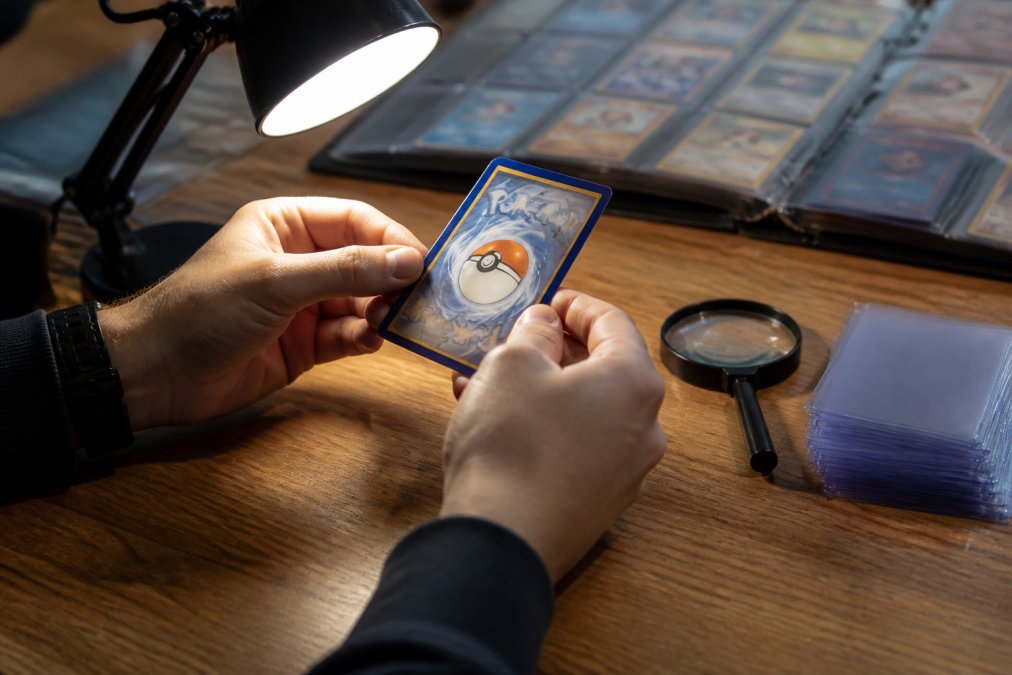
Near Mint (NM) cards show virtually no wear: sharp corners, clean surface, reasonable centering. This is the grade most collectors want for grading submissions.
Lightly Played (LP) cards have minor edge wear or light surface scuffs but no creases. They look clean in a sleeve.
Moderately Played (MP) cards show visible edge wear, whitening, or light scratching, no major creases, but obvious wear.
Grade |
Corners |
Surface |
Best For |
|---|---|---|---|
Near Mint |
Sharp |
Clean |
Grading, display |
Lightly Played |
Minor wear |
Light scuffs |
Binders, play |
Moderately Played |
Visible wear |
Scratched |
Budget play |
Heavily Played |
Rounded |
Heavy wear |
Casual decks |
Damaged |
Creased |
Severe |
Sleeved play only |
Buying Raw vs Graded Pokemon Cards: Which Fits Your Collection
The choice between raw and graded cards depends on whether you're optimizing for play value or resale certainty.
When Raw Makes Sense
Raw cards cost less and give you flexibility.
You can sleeve them, play them, or put them in a binder, and you decide later whether a card is worth sending for grading. For most binder pieces and playable cards, raw is the better value, because the cost of grading can be more than the card itself.
The catch is that you rely on the seller's condition grade. That is why it matters to buy from a shop that inspects every card before listing it, so a Near Mint card arrives as Near Mint.
When Graded Cards Are Worth the Premium
Graded cards make sense for high-value chase cards, where a certified condition score and a sealed case protect both the card and its resale value. You pay more up front, but you are not guessing about condition, and the slab is harder to fake or swap.
If you are buying mainly to hold or resell, graded is usually the safer route. If you are buying to collect and enjoy, raw Near Mint cards often give you more cards for the same budget.
Shipping, Packaging, and Buyer Protection for Pokemon Singles
Shipping quality separates professional sellers from casual ones. Here at Liberty TCG - we are really pleased that our customers regularly call out the care and attention we pay in shipping our cards.
A single card should arrive sleeved, in a top loader, and held firmly inside a rigid mailer so it cannot bend in transit. Higher-value orders should always ship with tracking.
Before you buy, check that the seller lists their packaging, includes tracking, and explains what happens if a card arrives damaged or in worse condition than described. A clear return or dispute process is part of what you are paying for.
Comparing Pokemon Singles Sources: Fees, Taxes, and Total Cost
The cheapest listed price rarely wins once you add everything up.
Platform Fees and Buyer Protection
Marketplaces rarely charge buyers a visible line-item fee; seller fees are baked into the listed price, so the same card can list higher on one platform than another even when the seller's net is identical.
Sales Tax and Nexus
Sales tax applies based on your state and the seller's economic nexus.
Large marketplaces collect sales tax on most orders, and many smaller online shops do too once they sell enough into your state. Expect tax to appear at checkout on most online purchases, and compare prices with it included.
Import Fees on Cross-Border Orders
Import charges only apply to international orders and are the most overlooked cost layer.
A card that looks cheaper from an overseas seller can end up costing more once customs duties, handling fees, and slower shipping are added. Buying from a domestic seller avoids these charges and usually gets the card to you faster.
Total-Cost Comparison
Cost Layer |
Typical Impact |
How to Reduce It |
|---|---|---|
Card price |
Largest single cost |
Buy multiple singles at once |
Shipping |
High on single-card orders |
Consolidate orders from one seller |
Sales tax |
Varies by state and seller nexus |
Unavoidable on most online purchases |
Import fees |
Only on international orders |
Buy domestically where possible |
Platform fees |
Built into listed prices |
Compare total, not sticker price |
Buyer protection |
Bundled or seller-managed |
Confirm dispute process before buying |
How to Run the Comparison
Put the same card in your cart at each source you are considering and go as far as the final checkout screen. Note the card price, shipping, tax, and any fees, then compare the totals side by side.
If you are buying several singles, run the comparison on the whole order. Consolidating cards from one seller usually cuts shipping more than any small price difference on a single card.
Building a Pokemon Singles Collection You Can Track
A collection is easier to grow when you know exactly what you own. Keep a simple spreadsheet or app with each card's name, set, condition, what you paid, and where you bought it.
Record the condition the day a card arrives, and store it the same day in a sleeve and top loader or a binder. That record makes it easy to spot duplicates, decide what to grade, and see how your collection's value changes over time.
Conclusion
The best place to buy Pokemon singles is the source that verifies authenticity, grades condition honestly, packages properly, and prices transparently.
Run the five-point authentication checklist on anything valuable, learn the condition scale so you know what you are paying for, and compare sources on total delivered cost rather than sticker price. At Liberty TCG, every single is hand-checked and sourced through authorized wholesale channels before it is listed, so you can buy online with confidence.
Frequently Asked Questions
Where is the best place to buy Pokemon singles online?
The best place to buy Pokemon singles depends on what you value most. Online marketplaces offer the widest selection, but you are often buying from individual sellers with varying track records. Look for sellers who provide clear condition photos, real tracking numbers - Liberty TCG lists singles starting at $0.50 with every card inspected before it goes live.
How can I tell if a Pokemon single is authentic?
Start with the light test: hold the card up to a bright light. Genuine Pokemon cards have a blue core layer visible through the back, while most counterfeits show a different color or none at all. Check the print quality of the text and energy symbols, which should be sharp and consistent. Look at the card back for proper color balance and border alignment. If you are buying from a shop that hand-checks inventory through authorized wholesale channels, you already have a layer of verification built in.
Should I buy raw or graded Pokemon cards?
Raw cards cost less and give you the freedom to handle them, sleeve them, and decide later whether to submit them for grading. Graded cards cost more upfront but come with a certified condition score and a tamper-evident case that protects the card. If you are building a collection to enjoy and play with, raw singles make sense. If you are investing in high-value cards and want verified condition, graded is the safer route. Many collectors do both, buying raw for the binder and graded for the display case.
What should I check before buying Pokemon singles from an online seller?
Check the seller's feedback score and read recent reviews for mentions of shipping damage or condition mismatches. Ask for additional photos if the listing only shows the front of the card. Confirm that the seller uses card sleeves and top loaders for shipping, and that tracking is included. A seller who hand-checks cards and sources through authorized wholesale channels will typically have no problem answering these questions.