

Table of Contents
- Why Authenticity Matters When Buying Pokémon Singles
- How to Spot Fake Pokémon Cards Before You Buy
- Pokémon TCG Condition Guide: Grading Basics for Collectors
- What to Look for in a Trustworthy Online Seller
- Featured Singles: Hand-Checked Cards Ready to Grade
- Authenticity Guarantee and Shipping Policies
- Safe Trading Practices for High-Value Cards
- Frequently Asked Questions
Last Updated: October 2, 2026
Why Authenticity Matters When Buying Pokémon Singles
Counterfeit Pokémon cards are everywhere. Collectors spend hundreds or thousands on singles they believe are authentic, only to discover later they've purchased fakes. The problem isn't just financial loss, it's the erosion of trust in the hobby itself. When you buy authentic pokemon singles online, you're protecting your collection, your investment, and your peace of mind.
Authenticity is the foundation of collecting. Whether you're building a portfolio of high-value cards or assembling a playable deck, every single card needs to be verified. Fake cards don't hold value. They won't grade. They won't sell. And if you're planning to get a card graded by PSA or BGS, submitting a counterfeit is a waste of time and money.
At Liberty TCG, we understand this pressure. We hand-check every card before it ships, and we source our inventory through authorized wholesale channels. This isn't just a promise, it's how we operate. Every card that leaves our warehouse has been physically inspected for the markers of authenticity that separate real from fake.
The good news: spotting counterfeits is learnable. You don't need a degree in card production to identify red flags. You need to know what to look for.
How to Spot Fake Pokémon Cards Before You Buy
Real Pokémon cards have specific visual and tactile characteristics that counterfeiters struggle to replicate consistently. Learning to spot these differences takes practice, but the effort pays off every time you open a package.
Print Quality and Card Stock
Authentic Pokémon cards have crisp, clean printing. The text is sharp. The borders are precise. The colors are vibrant and consistent across the entire card. Counterfeit cards often show blurry text, uneven color distribution, or printing that looks slightly off-register (where colors don't align perfectly).
Run your finger across the card surface. Real cards have a specific feel, smooth but not slick. The card stock itself should feel substantial, not flimsy. Fake cards often feel waxy, too thin, or have a texture that doesn't match authentic cards from the same set.
Check the corners. Authentic cards have clean, sharp corners. Counterfeit cards frequently have rounded or beveled corners, or corners that feel soft and fuzzy rather than crisp. This is one of the easiest tells if you're examining a card in person.
Holo Pattern and Texture
The holographic pattern on rare cards is one of the hardest elements to fake. Real holo patterns have a specific reflective quality and texture. When you tilt an authentic card under light, the holo pattern moves in a distinct way. The pattern should be uniform across the card's holo area.
Counterfeit holo patterns often look flat, dull, or have an inconsistent texture. Some fakes use a different holo pattern altogether, one that doesn't match the set's legitimate design. If you're familiar with a particular set, you'll recognize when the holo looks wrong.
Feel the holo area with your fingertip. Authentic cards have a raised, textured holo that you can feel. Counterfeit holo is often flat or has a different texture entirely. This tactile test catches many fakes immediately.
Text and Centering Issues
Authentic Pokémon cards have perfectly centered text and imagery. The card's borders should be even on all sides. The Pokémon illustration should be positioned consistently with other cards from the same set.
Counterfeit cards frequently suffer from centering problems. Text might be shifted to one side. The illustration might be off-center. The borders might be uneven. These errors are visible if you compare the card to a known authentic copy.
Check the attack text and card description. The font should match other cards from the same set exactly. Counterfeiters sometimes use slightly different fonts or font sizes, which becomes obvious when you compare cards side by side.
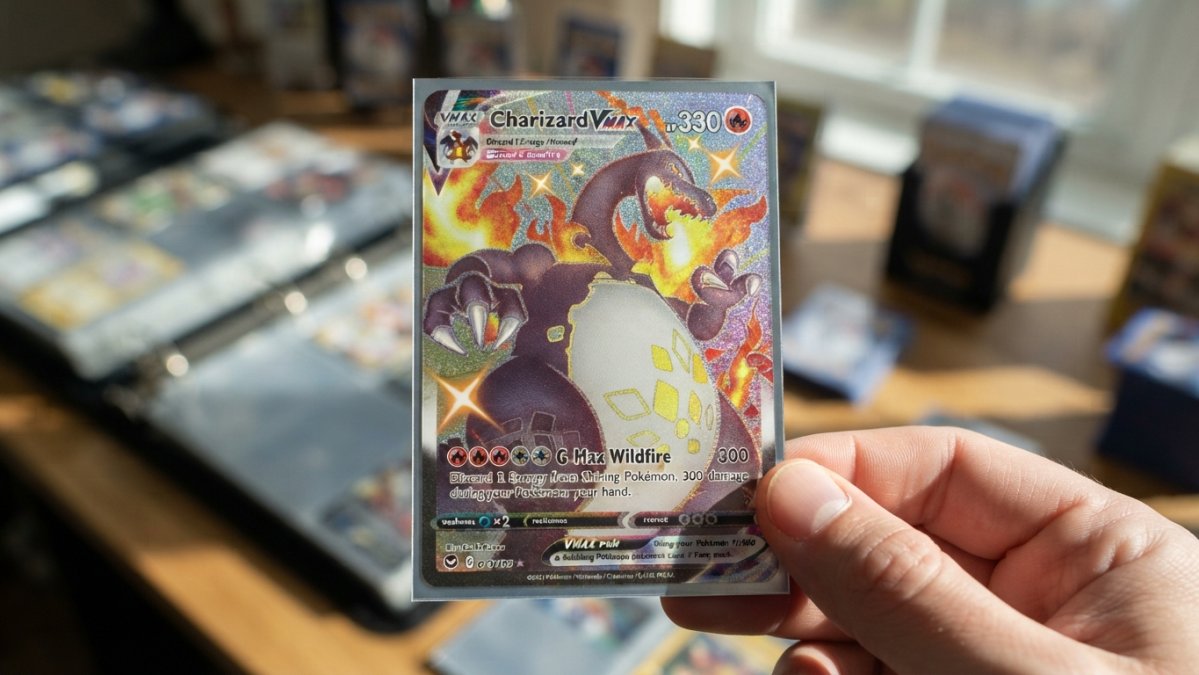
Pokémon TCG Condition Guide: Grading Basics for Collectors
Understanding card condition is essential for buying and selling singles. Condition determines value. A Near Mint card of the same card number can be worth 5 to 10 times more than a Played condition version. If you're planning to grade your cards, condition assessment becomes even more critical.
Near Mint vs. Raw Cards
Near Mint (NM) cards show minimal wear. The card has sharp corners, clean edges, and a pristine surface. There may be very light wear visible only under close inspection, but the card appears fresh and well-preserved. Near Mint cards are the sweet spot for collectors, they grade well and hold strong value.
Raw cards are ungraded cards still in their original condition, without a protective slab. Raw cards can be any condition grade, Mint, Near Mint, Lightly Played, Moderately Played, or worse. When you buy a raw card online, you're relying on the seller's condition assessment.
The difference between Near Mint and Lightly Played can be significant. A Near Mint card might grade a 7 or 8 from PSA. A Lightly Played card might grade a 5 or 6. That difference translates directly to resale value.
Pikachu ex - 149/128 [30C - 149/128] →
When evaluating a raw card, look for these signs of wear: soft corners, edge wear along the borders, slight surface scratches, or minor centering issues. A truly Near Mint card should have none of these. If you're buying raw cards online, request close-up photos of the corners and edges. This is where condition is most visible.
Graded Slabs and PSA/BGS Standards
Graded cards are authenticated and condition-assessed by third-party grading companies. PSA (Professional Sports Authenticator) and BGS (Beckett Grading Services) are the two major graders in the Pokémon market. When a card is graded, it's placed in a protective slab with a grade assigned.
PSA grades on a scale of 1 to 10:
- 10 = Gem Mint
- 9 = Mint
- 8 = Near Mint/Mint
- 7 = Near Mint
- 6 = Excellent/Mint
- 5 = Excellent
- 4 = Very Good/Excellent
- 3 = Very Good
- 2 = Good
- 1 = Poor
A PSA 8 or higher is considered investment-grade. Cards graded 7 and below are collectible but may not hold value as strongly. If you're building a portfolio of grading-ready cards, aim for cards that will likely grade 7 or higher.
BGS uses a similar scale but also assigns subgrades for corners, edges, centering, and surface. Some collectors prefer BGS subgrades because they provide more detail about what affects the overall grade.
When you buy graded cards, you're paying a premium for authentication and condition assurance. The slab itself protects the card from further wear. This is why graded cards are ideal for long-term collecting and investment.
What to Look for in a Trustworthy Online Seller
Not every online seller is equal. Some prioritize volume over quality. Others cut corners on sourcing. The best sellers, the ones worth returning to, share specific characteristics.
A trustworthy seller hand-checks inventory. Hand-checking means physically inspecting each card for authenticity, condition, and accuracy before listing it. This catches counterfeits, manufacturing defects, and misgraded cards before they ship to customers.
Look for sellers who source through authorized wholesale channels. This is the difference between a legitimate operation and one buying from questionable secondary markets. Authorized wholesale sourcing means the seller has established relationships with distributors and can verify the origin of their inventory.
Transparency about condition is non-negotiable. A trustworthy seller provides detailed photos of the card, front, back, corners, and edges.
Featured Singles: Hand-Checked Cards Ready to Grade
These cards represent the quality standard we maintain across our inventory. Each has been hand-checked and sourced through authorized wholesale channels.
| Card | Type | Rarity | Price | Best For |
|---|---|---|---|---|
| Pikachu ex - 149/128 | Lightning | Special Illustration Rare | $80.00 | Investment portfolios |
| Mew ex - 066/128 | Psychic | Double Rare | $9.00 | Budget collectors |
| Sylveon ex - 071/128 | Psychic | Double Rare | $2.00 | Deck building |
| Mew ex - 158/128 | Psychic | Futuristic Rare | $90.00 | High-value collecting |
Authenticity Guarantee and Shipping Policies
Every card shipped from Liberty TCG carries our authenticity guarantee. We hand-check before shipping. We source through authorized wholesale channels. If a card arrives and doesn't match our description or shows signs of counterfeiting, we make it right.
Safe Trading Practices for High-Value Cards
If you're trading high-value cards with other collectors, authentication becomes even more critical. Counterfeiters specifically target expensive cards because the financial stakes are higher.
Frequently Asked Questions
How can I tell if a Pokémon card is authentic when buying online?
Check the card stock weight and texture, authentic cards feel substantial and have a specific thickness. Examine the holo pattern under light; genuine cards show a consistent, precise pattern. Look at text clarity and centering; counterfeits often have blurry printing or off-center designs. Verify the seller sources from authorized wholesale channels and hand-checks every card before listing. Cards graded by PSA or BGS provide third-party authentication that eliminates guesswork.
What's the difference between raw cards and graded slabs?
Raw cards are ungraded singles in their original condition. Graded slabs are cards encased in protective holders with a numerical condition grade (typically 1-10 scale) assigned by professional graders like PSA or BGS. Graded cards cost more but provide authentication, condition documentation, and easier resale on the secondary market. For investment-focused collectors, grading-ready raw cards from hand-checked inventory offer the best value before professional grading.
Why should I buy from a verified seller instead of a marketplace?
Verified sellers hand-check inventory, source from authorized wholesale channels, and stand behind authenticity guarantees. A trustworthy seller provides transparent return policies, documents card condition accurately, and builds community trust through consistent practices. This reduces the risk of receiving damaged cards or counterfeits and ensures grading-ready quality.
What should I look for in a Pokémon TCG condition guide before buying?
A reliable condition guide explains the grading scale (near mint, lightly played, moderately played, heavily played) with visual examples. It covers manufacturing defects, edge wear, corner damage, and surface scratches. Understanding condition standards helps you assess whether a card is truly grading-ready or needs realistic expectations. Sellers who provide detailed condition notes and photos demonstrate transparency about what you're purchasing.