

Table of Contents
- What Makes a Pokemon Card Grading Service Reliable
- How to Prepare Pokemon Cards for Grading
- How Long Does Pokemon Card Grading Take?
- Is Professional Grading Worth It for Pokemon Cards?
- Sub-Grades, Slab Quality, and Post-Grading Storage
- Pricing Breakdown and Tiered Structures for Pokemon Card Grading
- Frequently Asked Questions
Last Updated: September 16, 2026
What Makes a Pokemon Card Grading Service Reliable
A reliable Pokemon card grading service combines consistent authentication, transparent grading standards, and tamper-evident encapsulation that holds up over time. This guide from Liberty TCG breaks down what separates trustworthy graders from the rest, so you can submit with confidence.
Reliability comes down to three things: verified authentication, consistent condition assessment, and slab quality you can inspect before you commit. Get any one of those wrong and the certification number on the label means very little.
The collector community has learned this the hard way. When grading standards drift between submissions, a pristine grade on one card doesn't guarantee the same treatment on the next. That inconsistency is the single biggest reason collectors switch services, and it's why the checklist below matters more than any marketing claim.
Authentication vs. Condition Assessment
Authentication confirms a card is genuine: correct print patterns, proper holographic elements, and paper stock that matches the era. Condition assessment then scores what the card actually looks like.
These are separate jobs, and a service that handles one well may still stumble on the other. Authentication protects you from counterfeits. Condition assessment determines your centering, surface quality, corner wear, and edge integrity scores.
Grading Scale Consistency and Accuracy
Consistency is the hardest thing to prove from the outside. A service can advertise accuracy, but only a population report shows whether its grades cluster sensibly across thousands of submissions.
How to Prepare Pokemon Cards for Grading
Prep work decides more outcomes than most collectors realize. A dinged corner from careless handling can cost you an entire grade, and that loss is permanent once the card is encapsulated.
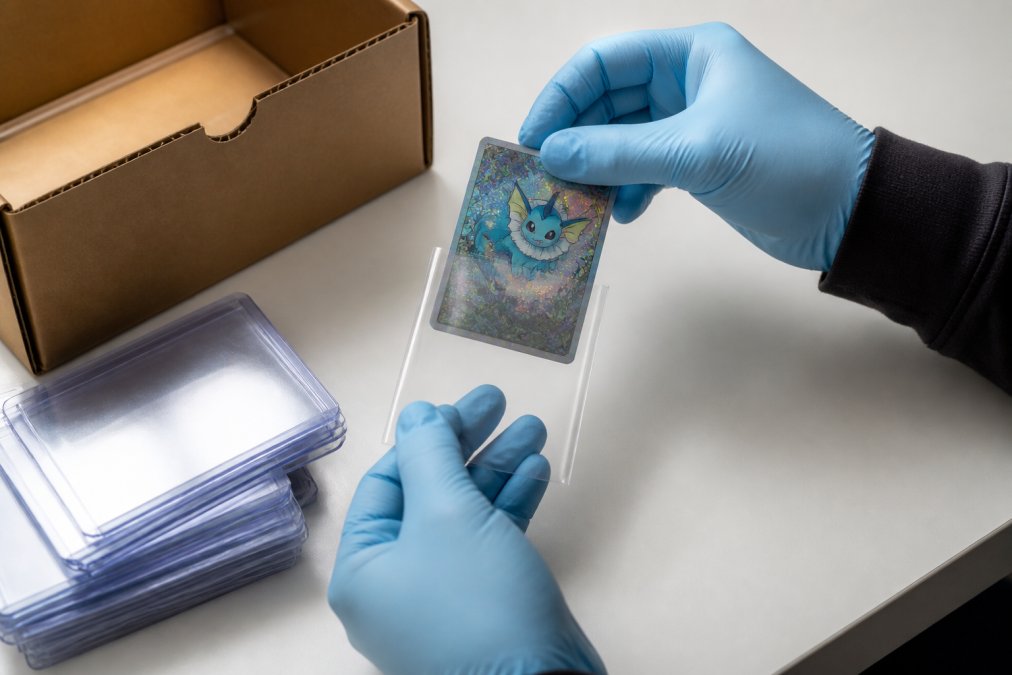
Here's the sequence that protects your submission:
- Wash and dry your hands, or wear nitrile gloves
- Work on a clean, well-lit surface away from food and drink
- Handle cards by the edges only, never the surface
- Place each card in a fresh penny sleeve, then a rigid card saver
- Sandwich the stack between cardboard and seal with tape
- Use a padded box with tracking and shipping insurance for high-value cards
Handling, Sleeving, and Shipping Supplies
Cheap supplies are a false economy. Penny sleeves and card savers cost little, and they're the difference between a card arriving intact and arriving with fresh surface scratches.
How Long Does Pokemon Card Grading Take?
Turnaround time is quoted from the day your order is logged into the grading queue, not the day you drop it at the post office. That distinction matters, because shipping both ways can add a week or more on top of the advertised window, and the clock doesn't start until the service checks your cards in.
Turnaround Tiers, Shipping Costs, and Bulk Submission
Most services structure tiers around two variables: how fast you want the card back, and how much the card is worth. Speed costs money, and declared value drives the service's liability, so the two are linked.
| Tier | Relative Speed | Best For | Trade-off |
|---|---|---|---|
| Economy | Slowest | Large personal collections | Longest wait, lowest cost per card |
| Standard | Moderate | Mixed personal and resale | Balanced cost and speed |
| Express | Fast | Time-sensitive sales | Highest cost per card |
| Bulk | Varies by count | 50+ cards at once | Discounted rate, longer queue |
Shipping and Insuring High-Value Cards
This is the part most guides skip, and it's where beginners lose the most money. The grading fee is only one line item, the round-trip shipping and insurance bill can rival it on a small submission.
- Declared value is your coverage ceiling. When you ship, the carrier's liability is capped at the declared value you write on the form. If you under-declare to save on postage, you've capped your own payout. If a package goes missing, the receipt and declared-value documentation are the only things that get you paid.
- Signature confirmation is cheap insurance. For anything above a few hundred dollars, require a signature on delivery. It removes the "it was left on the porch" dispute.
- Ship in a rigid box, not an envelope. Cards should sit flat with no room to shift. Sandwich the stack between cardboard, seal it, and fill any void so nothing slides.
- Keep the receipt and tracking number. Photograph the packed box and the label before you hand it over. If a claim is needed, that documentation is the difference between a payout and a shrug.
- Insure the return leg too. Some services offer insured return shipping as an add-on. Ask before you submit, not after.
Is Professional Grading Worth It for Pokemon Cards?
Professional grading is worth it when the card's raw market value is high enough that a verified grade meaningfully changes what a buyer will pay. For low-value cards, the cost of grading can exceed the value it adds.
Grading for Personal Collection vs. Investment Flipping
These two goals pull in different directions, and mixing them up is a common mistake.
- Personal collection: Grade cards you love, especially ones you'll display or pass on. Slab protection and a certification number add long-term preservation value even if you never sell.
- Investment flipping: Grade only where the expected graded value clearly exceeds raw value plus grading and shipping costs. Run the math before you submit, not after.
Sub-Grades, Slab Quality, and Post-Grading Storage
Sub-grades break a final score into its components: centering, corners, edges, and surface. Two cards with the same overall grade can have very different sub-grade profiles, and buyers notice.
Pricing Breakdown and Tiered Structures for Pokemon Card Grading
Grading pricing is tiered by declared value and turnaround speed, and the structure rewards planning. Declared value tiers exist because the service's liability scales with your card's worth, so undervaluing a card to save on fees can void your coverage if something goes wrong.
The Real Cost Stack
The grading fee is only the first line item. A complete cost picture includes:
- Per-card grading fee for your chosen tier
- Shipping to the grader, plus insurance on the declared value
- Return shipping and insurance, which some services bundle and others charge separately
- Supplies, penny sleeves, card savers, cardboard, tape, a rigid box
- Your time, which matters more on bulk submissions than most people admit
Declared Value: The Trap That Voids Coverage
Declared value is the number you write on the shipping form and the number the service uses to set its liability. Two mistakes are common:
- Under-declaring to save on postage. You pay less up front, but if the package is lost or damaged, your payout is capped at the number you wrote. On a high-value card, that's a self-inflicted loss.
- Over-declaring to inflate coverage. This raises your shipping cost and can trigger scrutiny. Declare what the card is actually worth raw, not what you hope it grades into.
Grading for Personal Collection vs. Investment Flipping
These two goals pull in different directions, and mixing them up is a common mistake.
- Personal collection: Grade cards you love, especially ones you'll display or pass on. Slab protection and a certification number add long-term preservation value even if you never sell. The math doesn't need to clear a profit threshold, it needs to clear your enjoyment threshold.
- Investment flipping: Grade only where the expected graded value clearly exceeds raw value plus grading, shipping, and insurance costs. Run the math before you submit, not after. A thin spread means you're working for free.
Frequently Asked Questions
Which Pokemon card grading service is the most reliable?
Reliability comes down to three things: consistent grading standards, transparent turnaround times, and tamper-evident slab protection. Look for services that publish population reports, use certification numbers you can verify online, and offer tiered pricing that matches your declared value. A reliable Pokemon card grading service will also explain how it handles authentication versus condition assessment, so you know exactly what you are paying for before you ship.
How much does it cost to have a Pokemon card professionally graded?
Costs vary by service level, declared value, and turnaround time. Bulk submission discounts often apply. Always factor in shipping insurance for high-value cards, since a single lost package can wipe out the savings from a cheaper tier.
How long does Pokemon card grading take?
Turnaround time depends on the tier you choose. Economy submissions often take 45 to 90 business days, standard tiers run 20 to 45 business days, and express options can finish in under two weeks. Add shipping time both ways. During peak release windows, expect delays. If you are grading for a personal collection rather than resale, the cheapest tier is usually fine.
Is professional grading worth it for lower-value Pokemon cards?
For lower-value cards, grading rarely pays off financially. The grading fee, shipping, and insurance can exceed the card's graded value. That said, grading makes sense for sentimental cards you want preserved in a tamper-evident slab, or for cards with a realistic shot at a gem mint grade that would jump in resale value. Run the math on market demand before submitting.
What should collectors look for when choosing a grading company?
Check four things: grading scale consistency, population report transparency, slab quality and protection, and how the company handles sub-grades like centering, surface quality, corner wear, and edge integrity. Also review shipping insurance options and whether the service offers bulk submission pricing. A reliable grader will publish clear tier details and let you verify every certification number online.
Grading only pays off when the cards you submit are actually worth the fee, and that starts with the cards themselves. Liberty TCG hand-checks every card before it's listed, sources inventory through authorized wholesale channels, and prices sealed products below market rates, with local pickup available if you'd rather inspect in person. Build your submission from cards that deserve the slab. Browse the grading-ready pulls at Liberty TCG and start your next submission with confidence.