

Table of Contents
- Understanding Pokémon Card Condition Grades
- What Near Mint Pokémon Card Meaning Really Tells You
- The Four Pillars of Card Inspection: Corners, Edges, Surface, and Centering
- How to Inspect Pokémon Cards Before Buying
- Pokémon Card Whitening: Detection and What It Means
- How to Spot Fake Pokémon Cards During Condition Checks
- Raw Cards vs. Graded Cards: Understanding the Value Gap
- Handling and Storage Best Practices
- Frequently Asked Questions
Last Updated: October 7, 2026
Understanding Pokémon Card Condition Grades
When you buy a Pokémon card, condition determines playability, collectibility, and resale value. The pokemon card condition you receive decides whether you got a fair deal or overpaid for damage you didn't see coming.
Most grading systems use a standardized scale. Knowing what each grade actually means, not what sellers claim, separates informed buyers from those who learn the hard way.
Near Mint (NM) vs. Lightly Played (LP) vs. Moderately Played (MP)
Near Mint (NM) cards show minimal to no visible wear: sharp corners, clean edges, centered printing, and a pristine surface under normal lighting.
Lightly Played (LP) cards show light wear from careful handling: minor corner rounding, slight edge wear, and faint scratches visible only under magnification.
Moderately Played (MP) cards show obvious wear from regular play: noticeably rounded corners, visible edge wear, and surface scratches apparent under normal light.
Heavily Played (HP) and Damaged Cards
Heavily Played (HP) cards are visibly worn from extensive play, with heavily rounded corners, significantly worn edges, and obvious surface damage. They still function as playable copies.
Damaged cards have structural issues: creases, dents, stains, or severe bends affecting playability or display value. They're the cheapest option, best reserved for budget deck-builders rather than collectors.
What Near Mint Pokémon Card Meaning Really Tells You
A Near Mint pokemon card isn't flawless, it's a card that looks fresh and handles like it was barely touched. The definition matters because grading companies use "Near Mint" differently than casual sellers.
The catch: many sellers label cards "Near Mint" when they're actually LP or MP, using looser standards. At Liberty TCG, we hand-check every card before listing against professional grading standards, so a card we list as NM meets or exceeds what a professional grader would call Near Mint.
The Four Pillars of Card Inspection: Corners, Edges, Surface, and Centering
Professional graders evaluate pokemon card condition across four areas. Knowing them helps you spot issues before you buy.
Corner Wear and Edge Chipping
Corners take the most abuse. Even careful handling rounds them over time. When inspecting, look for:
- Sharp corners (NM standard): Corners come to a defined point with no rounding
- Slight rounding (LP standard): Corners are softly rounded but still defined
- Obvious rounding (MP standard): Corners are noticeably rounded with visible wear
Edge chipping is distinct from corner wear: small pieces of the edge break away, creating visible white spots along the border. Even one chip can drop a card from NM to LP or MP, and chips are permanent.
Surface Scratches and Holo Scratching
The surface, especially the holographic layer on holo cards, reveals condition under magnification. Scratches come in two types:
Micro-scratches are hairline marks visible only under a jeweler's loupe or strong magnification. NM cards may have one or two; LP cards typically have several. They don't affect playability but matter for grading.
Holo scratching refers to visible scratches on the holographic portion. They catch light and create visible lines, so even light holo scratching can drop a card from NM to LP; heavy scratching is a hallmark of MP or HP cards.
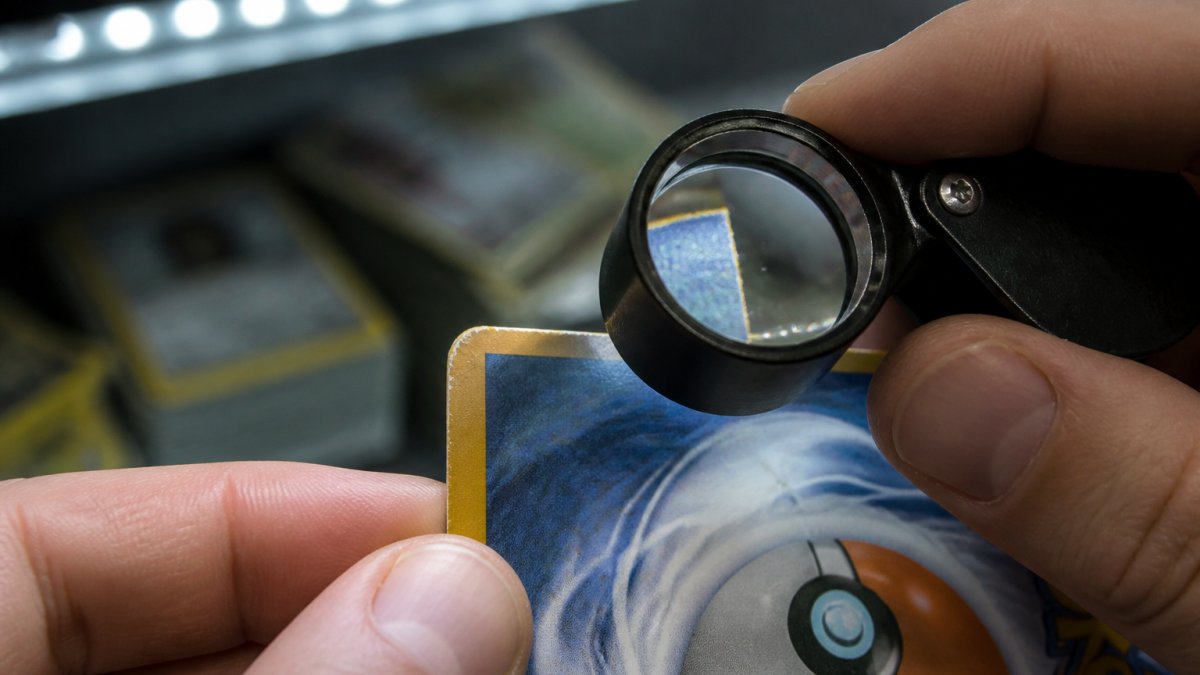
Use a 10x jeweler's loupe under bright LED lighting to assess surface condition. Natural light is insufficient; you need bright, directional light to see scratches clearly.
Centering, Print Lines, and Off-Center Printing
Centering refers to how the printed image sits within the card's borders. Perfectly centered cards have equal white borders on all sides; off-center cards have uneven borders.
Slight off-centering is common in older sets and doesn't significantly impact NM grading. Moderate off-centering drops cards to LP. Severe off-centering indicates MP or worse.
Print lines are thin lines or streaks from the printing process. They're manufacturing defects, not wear, but they still affect condition grades.
How to Inspect Pokémon Cards Before Buying
Before buying, conduct a systematic inspection. It takes 5-10 minutes but prevents costly mistakes.
Lighting and Magnification Techniques
Start with proper lighting. Natural daylight is insufficient; use a bright LED source such as a 5000K desk lamp, positioned at a 45-degree angle to the surface to reveal scratches and holo imperfections that overhead lighting misses.
For detailed work, use a 10x jeweler's loupe to reveal micro-scratches, print lines, and defects invisible to the naked eye.
Photograph the card under this lighting with your phone. The photo captures details you might miss and documents condition at purchase, proving what you ordered versus what arrived.
What to Ask Sellers for in Photos
When buying online, request specific photos:
- Front and back under bright lighting - Shows overall condition and centering
- Close-ups of all four corners - Reveals corner rounding and wear
- Close-ups of top and bottom edges - Exposes edge chipping and wear
- Holo surface under angled lighting - Displays scratches and surface defects
- Photos under magnification (if possible) - Shows micro-scratches and print defects
Sellers who provide detailed photos are transparent; those offering only one generic shot are signaling hidden problems. At Liberty TCG, we provide detailed condition photos for every card, including magnified shots of high-value singles.
Pokémon Card Whitening: Detection and What It Means
Whitening is permanent and affects appearance and resale value.
To detect whitening, examine the edges under bright lighting and compare them to the surface color. If edges look noticeably lighter or whiter, whitening has occurred.
Moisture-related whitening suggests improper storage and may hide internal damage like swelling or warping. Avoid such cards unless they're extremely rare or you're buying for play, not collection.
How to Spot Fake Pokémon Cards During Condition Checks
Counterfeits are a growing problem in the Pokémon market. During inspection, watch for these signs:
Print quality - Authentic cards have sharp, clean printing. Fakes show blurry text, misaligned colors, or ink bleeding. Use magnification to check text sharpness and color registration.
Card stock - Real Pokémon cards have a specific feel and weight; fakes often feel thinner or flimsy.
Borders and edges - Fakes frequently have uneven borders, rough edges, or printing extending beyond the border.
Texture and finish - Authentic cards have a subtle, consistent texture; some fakes feel too smooth or too rough.
When buying from unknown sellers, request photos next to a known authentic card for comparison.
Raw Cards vs. Graded Cards: Understanding the Value Gap
A raw card is ungraded, with no professional certification of condition.
Graded cards typically command higher prices than raw cards of the same condition because grading provides third-party verification, reducing buyer risk.
However, grading isn't always worth the cost. Grading takes weeks or months. For a $20 card, costs exceed the card's value; for a $500+ card, the added credibility and resale value justify it.
Consider grading if:
- The card is worth $200+
- You plan to sell or trade the card
- You want professional verification of condition
Skip grading if:
- The card is worth under $100
- You're keeping the card long-term for personal collection
- You trust the seller's condition assessment
At Liberty TCG, we source grading-ready cards: raw cards that meet professional grading standards without the grading cost. Cards like the Moltres - 130/128 are hand-checked and ready for grading if you pursue it later.
![Moltres - 130/128 [30C]](https://cdn.shopify.com/s/files/1/1004/1907/6392/files/716219.jpg?v=1789660147)
Handling and Storage Best Practices
How you handle and store cards determines whether condition stays stable or degrades. Follow these practices:
Use proper sleeves - Store cards in archival-quality, acid-free, PVC-free sleeves. Penny sleeves suit bulk storage; upgrade valuable cards to premium sleeves.
Store in cool, dry conditions - Moisture and heat damage cards. Store cards in a climate-controlled environment (60-75°F, 30-50% humidity).
Avoid stacking raw cards - Stacking creates pressure that can cause bending or corner damage.
Handle minimally - Oils from your hands damage cards.
Keep graded cards in slabs - Graded cards are protected by their slabs.
Proper storage preserves condition and protects your investment.
Buying Pokémon cards with confidence starts with understanding condition. Whether you're building a personal collection or investing in grading-ready singles like the Zapdos - 133/128, condition knowledge protects your purchase and maximizes your value.
![Zapdos - 133/128 [30C]](https://cdn.shopify.com/s/files/1/1004/1907/6392/files/716221.jpg?v=1789660151)
Frequently Asked Questions
What does Near Mint Pokémon card meaning actually include, does it have to be perfect?
Near Mint cards show minimal wear from careful play or storage. They may have very light corner rounding, barely visible surface wear, or slight centering issues, but no creases, dents, or major scratches. The card stock remains clean with no whitening on edges. Near Mint cards command premium prices because they're grading-ready and retain strong market value.
How do I inspect Pokémon cards before buying online if I can't see them in person?
Request high-resolution photos under bright lighting from multiple angles: front, back, close-ups of corners and edges, and the holo area if present. Ask the seller to show the card's centering by photographing the border width. Use a jeweler's loupe (10x magnification) if you receive the card to verify condition matches the listing. Reputable sellers like Liberty TCG hand-check every card before listing and stand behind their condition assessments.
What is Pokémon card whitening and how can I spot it?
Whitening occurs when the card's edges or corners show the white cardstock layer underneath the colored border, caused by wear, handling, or shuffling. You'll see a visible white line or spot where the finish has worn away. Whitening is common on Lightly Played and Moderately Played cards and significantly reduces condition grade and value. Inspect edges and corners under bright light or magnification to catch even light whitening before buying.
How can I tell if a Pokémon card is counterfeit when checking condition?
Authentic cards have sharp, clean printing with consistent ink saturation and no blurring. Counterfeits often show fuzzy text, misaligned colors, or poor holo quality. Check the card stock weight and feel, genuine cards are thicker and heavier than fakes. Examine the holo pattern closely; authentic holos have precise, repeating patterns while counterfeits show irregular or muddy patterns. Buy from authorized wholesale sources like Liberty TCG to eliminate counterfeit risk entirely.
Does off-center printing lower a Pokémon card's condition grade and value?
Yes, centering affects condition grade significantly. Off-center cards show uneven border width on the front or back, which grading services like PSA penalize. Moderate centering issues may drop a card from Near Mint to Lightly Played. Severe off-center printing can reduce value depending on the card's rarity. Always check centering in photos before purchasing, especially for high-value cards you plan to grade.
What's the difference between raw and graded Pokémon cards in terms of condition and value?
Raw cards are ungraded singles you buy as-is; graded cards have been certified by services like PSA or BGS with an assigned condition number (1-10). Graded cards command a premium because the grade is verified and protected in a slab. Grading-ready raw cards in Near Mint condition can be worth a significant portion of their graded equivalent. Choose grading for high-value cards; raw cards work fine for personal collections.
What inspection tools do I actually need to assess Pokémon card condition accurately?
A 10x jeweler's loupe is essential for spotting micro-scratches, holo scratching, and whitening. Bright LED lighting (at least 2000 lumens or daylight-balanced) reveals surface defects and centering issues clearly. A microfiber cloth removes dust without scratching. Toploaders and card sleeves protect cards during inspection. You don't need expensive grading equipment, these basic tools let you assess condition reliably before buying or sending cards for professional grading.
Can a Pokémon card look Near Mint in photos but have hidden damage when it arrives?
Yes, especially if photos are taken under poor lighting or at angles that hide flaws. Sellers may photograph only the best side or use filters. Request photos from multiple angles under bright, natural light, and ask specifically about centering, edge wear, and holo condition. Trusted sellers like Liberty TCG provide detailed condition assessments and hand-check every card before shipping. Always verify condition matches the listing when the card arrives; reputable sellers offer returns if condition doesn't match.