

Table of Contents
- What It Means to Build a Pokémon Card Portfolio
- Best Pokémon Card Sets 2026 for Portfolio Growth
- How to Track Pokémon Card Values and Market Trends
- Pokémon Card Grading Guide: Raw vs. Graded Cards
- Organizing and Managing Your Collection
- Risk Management and Diversification Strategies
- Exit Strategies and Liquidation Planning
- Frequently Asked Questions
Last Updated: October 4, 2026
What It Means to Build a Pokémon Card Portfolio
To build pokemon card portfolio means strategically acquiring cards with the intention of growing their value over time while maintaining collection quality and authenticity. Unlike casual collecting, portfolio building treats your cards as financial assets that require tracking, organization, and deliberate acquisition decisions.
The distinction matters. Casual collectors buy cards they love. Portfolio builders buy cards they believe will appreciate. Both approaches are valid, but they demand different strategies. A portfolio requires you to understand market value, condition standards, and exit opportunities. You're not just accumulating; you're investing.
At Liberty TCG, we work with collectors who approach cards as assets. Hand-checking every card before listing and sourcing through authorized wholesale channels ensures the foundation of any strong portfolio is authenticity. Counterfeit cards destroy value instantly. Real cards, properly graded and stored, can appreciate significantly over years.
The core elements to build pokemon card portfolio include selecting sets with proven appreciation potential, tracking values systematically, understanding grading standards, organizing inventory for easy management, and planning your eventual exit strategy. Each element builds on the others. Without tracking, you won't know if your selections are working. Without organization, you can't manage a growing collection efficiently. Without an exit plan, you're holding assets with no clear endpoint.
Best Pokémon Card Sets 2026 for Portfolio Growth
The strongest portfolio sets share common characteristics: limited print runs, iconic Pokémon, playable cards in the competitive format, and proven collector demand. Sets from the Sword & Shield era and modern Scarlet & Violet expansions have shown consistent appreciation when cards are graded or kept in near-mint condition.
Crown Zenith and Twilight Masquerade represent solid 2026 portfolio additions. The Twilight Masquerade Elite Trainer Box includes 9 booster packs with cards featuring Tera Pokémon ex and the masked Legendary Ogerpon, mechanics that appeal to both competitive players and collectors seeking long-term appreciation.
Sealed products like the Sword & Shield Ultra-Premium Collection: Charizard hold value through condition preservation and rarity. Charizard remains one of the most sought Pokémon across all eras. The etched foil promo cards in this collection, Charizard V, VMAX, and VSTAR, represent three distinct power levels that appeal to different collector segments.
![Sword & Shield Ultra-Premium Collection: Charizard [SWSH11 - 0]](https://cdn.shopify.com/s/files/1/1004/1907/6392/files/282401.jpg?v=1788618282)
When selecting sets for portfolio growth, prioritize those with:
- Limited print runs or exclusive distribution
- Iconic Pokémon with sustained demand
- Multiple card rarities within the set
- Proven secondary market liquidity
The Crown Zenith Pokemon Center Elite Trainer Box Plus and Twilight Masquerade Elite Trainer Box are available at Liberty TCG, making them strong entry points for portfolio builders starting their collections.
How to Track Pokémon Card Values and Market Trends
Tracking card values requires a system that captures purchase price, current market value, and historical appreciation. Without this data, you're guessing whether your portfolio is performing.
Start with a spreadsheet template that includes: card name, set code, card number, condition (raw or graded), purchase price, current market value, date acquired, and notes on condition or special characteristics. Update market values monthly using publicly available price discovery sources. The gap between your cost basis and current market value reveals your return on investment.
Market trends shift based on several factors. Competitive viability in the Pokémon Trading Card Game format drives short-term demand for playable cards. Nostalgia cycles boost older sets when anniversaries or new game releases occur. Grading availability affects sealed product values.
Document price history over at least 6-12 months to identify patterns. Cards that appreciate steadily outperform those that spike and crash. Steady appreciation suggests real collector demand. Volatile spikes often precede corrections.
Pay attention to market volatility. Cards that swing 20-30% in value month-to-month are riskier holdings. Cards appreciating 5-10% annually show more stable growth patterns. Your portfolio's overall volatility depends on the mix of stable and volatile holdings.
Pokémon Card Grading Guide: Raw vs. Graded Cards
Graded cards are authenticated and assigned a condition grade on a scale from 1-10, with 10 being gem mint. Grading adds cost and turnaround time, but it protects value, simplifies future sales, and creates a verifiable record of condition at the moment of grading. Raw cards are ungraded; they cost nothing to grade upfront, but their value depends entirely on your honest assessment of condition and the buyer's trust in that assessment.
The grading decision is not just about cost, it's a portfolio strategy decision that affects liquidity, volatility, and exit timing.
Grading for Value Protection
Cards worth $50 or more benefit from professional grading because the grade locks in condition at the time of grading. This protects you against buyer skepticism about raw card condition. When you sell a graded card, the buyer pays for the grade, not your word.
Cards worth under $20 raw rarely justify grading costs. The grading fee often exceeds the value premium a grade would add. However, if you believe a raw card will appreciate significantly and you plan to hold it long-term, grading it early locks in condition.
Grading for Liquidity and Exit Speed
Graded cards sell faster than raw cards in most market conditions. When you need to liquidate quickly, whether due to portfolio rebalancing or personal circumstances, graded cards move more reliably.
Raw cards appeal to budget-conscious buyers and dealers who will regrade or resell raw. If your exit timeline is flexible and you're willing to accept lower prices for faster sales, raw cards work. If you need predictable liquidity, grading is insurance.
Grading for Market Timing
Grading turnaround times create a strategic timing consideration. When grading services have long backlogs, sealed products and raw cards become relatively more valuable. Conversely, when turnaround times are short, graded cards become more attractive because the cost and wait are lower.
If you acquire a raw card you believe will appreciate, consider grading it during periods of short turnaround times. This locks in condition while the cost is low and the service is fast.
Hybrid Grading Strategy for Portfolio Balance
Most successful portfolio builders use a tiered approach:
- Tier 1 (highest value, >$200 raw): Grade all cards. The value premium and liquidity benefit justify the cost.
- Tier 2 (mid-value, $50-$200 raw): Grade selectively. Grade cards you plan to hold long-term or believe will appreciate significantly. Leave others raw if you're comfortable with the liquidity trade-off.
- Tier 3 (lower value, <$50 raw): Keep raw unless the card is iconic (e.g., a Charizard or Mewtwo) and you expect significant appreciation.
- Sealed products: Grade only if you plan to sell unopened. Most sealed products appreciate better ungraded because grading requires opening the seal.
This approach balances cost control with value protection. You're not grading everything (which wastes money on low-value cards), but you're protecting your highest-value holdings.
Common Grading Mistakes
- Submitting cards with visible defects and expecting high grades. Know the card's likely grade before submitting.
- Grading low-value cards and losing money on the grading fee.
- Assuming raw cards in your collection are higher grade than they actually are. Be honest about condition. If you're uncertain, compare the card to graded examples online.
- Waiting too long to grade cards. Grade high-value cards within 1-2 years of acquisition to lock in condition while it's still strong.
- Grading during service backlogs.
Grading and Portfolio Rebalancing
When you rebalance your portfolio (selling some holdings to reduce concentration), grading status affects your options. A graded card can be sold immediately at the grade's market price. A raw card requires photos, descriptions, and negotiation. If you need to liquidate a position quickly, graded cards give you more control over timing and price.
Organizing and Managing Your Collection
Organization systems prevent loss, enable quick inventory checks, and simplify selling when you decide to exit. A disorganized collection becomes impossible to value accurately.
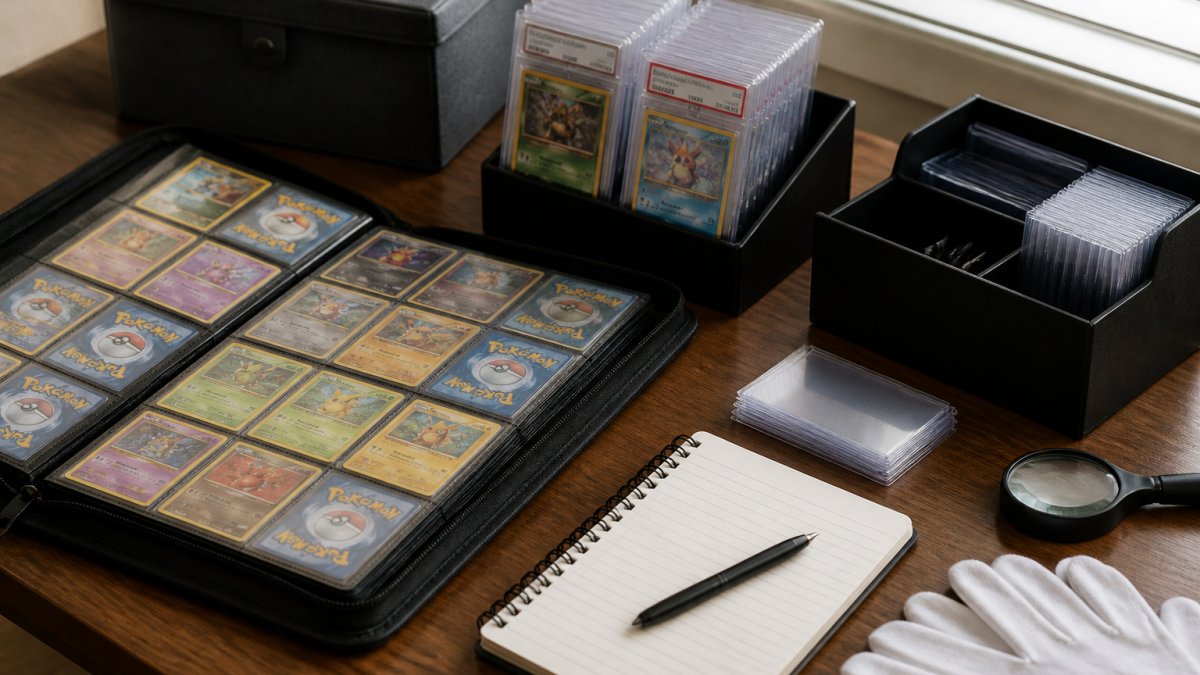
The most common approach is organizing by set first, then by card number within each set. This structure mirrors how cards are numbered in official checklists and makes finding specific cards intuitive. Binders with card sleeves work for lower-value cards. Graded cards in protective cases should be stored separately in acid-free storage boxes.
Create a master inventory spreadsheet that mirrors your physical organization. Include columns for set, card number, card name, quantity, condition (raw/graded), grade (if applicable), location in your collection, and current market value. This spreadsheet becomes your portfolio dashboard, sort by market value to see your highest-value holdings, sort by set to audit your collection against your binder, sort by date acquired to review your acquisition patterns.
Update your inventory quarterly at minimum. New cards added, cards sold, and market value changes all need recording. Quarterly updates catch problems early, missing cards, condition changes you didn't notice, or sets where you're overconcentrated.
Diversification across sets reduces risk. Holding 60% of your portfolio in one set exposes you to that set's specific market volatility. Spreading holdings across 5-8 sets with different release dates, mechanics, and collector appeal smooths returns.
Risk Management and Diversification Strategies
Concentration risk is real in card portfolios. A single set losing collector interest can damage your overall returns significantly. A portfolio where 60% of value is tied to one Pokémon (e.g., Charizard) is vulnerable to that Pokémon's demand cycle. Diversification means spreading your capital across multiple sets, release dates, card types, and Pokémon to smooth returns and reduce idiosyncratic risk.
Building a Diversified Portfolio Structure
Sword & Shield Ultra-Premium Collection: Charizard [SWSH11 - 0] →
Start by defining your allocation targets across these dimensions:
By Era (Release Date)
- Allocate 30-40% to established sets (2+ years old).
- Allocate 40-50% to recent sets (released within the last 12 months).
- Allocate 10-20% to sealed products.
This mix balances stability (older sets) with upside (newer sets).
By Rarity and Card Type
- Allocate 50-60% to chase cards (Pokémon ex, VSTAR, full-art cards).
- Allocate 30-40% to mid-tier cards (holos, reverse holos, trainer cards).
- Allocate 10% to bulk or lower-value cards.
By Condition (Raw vs. Graded)
- Allocate 60-70% to graded cards.
- Allocate 30-40% to raw cards.
This mix ensures you have liquid, stable holdings (graded) while maintaining exposure to upside (raw cards).
By Pokémon
- Avoid holding more than 15% of your portfolio in any single Pokémon.
- Spread holdings across 8-12 different Pokémon to reduce idiosyncratic risk.
- Include a mix of iconic Pokémon and emerging Pokémon.
Measuring Concentration Risk
Track your portfolio concentration quarterly using your inventory spreadsheet. Calculate the percentage of total portfolio value held in:
- Your top 5 cards
- Your top 3 sets
- Your top 3 Pokémon
- Graded vs. raw cards
- Sealed vs. single cards
If any single dimension exceeds 50% of your portfolio value, you have concentration risk.
Rebalancing Rules
Rebalance your portfolio quarterly or when any single dimension exceeds your target allocation by more than 10 percentage points. Rebalancing means selling overweight positions and buying underweight positions to return to your target allocation.
Example: You target 50% chase cards, 40% mid-tier, 10% bulk. Your portfolio drifts to 65% chase cards (because chase cards appreciated faster). Sell 15% of your chase card value and use the proceeds to buy mid-tier cards. This locks in gains from chase cards and rebalances risk.
Rebalancing also forces you to "sell high." When a set or Pokémon appreciates significantly, rebalancing requires you to trim that position.
Sealed Products as Diversification
Sealed products (Elite Trainer Boxes, booster boxes, special collections) diversify your portfolio in ways single cards cannot.
![Crown Zenith Pokemon Center Elite Trainer Box Plus [CRZ - 0]](https://cdn.shopify.com/s/files/1/1004/1907/6392/files/454246.jpg?v=1788618277)
Allocate 10-20% of your portfolio to sealed products. This provides diversification without overcommitting to unopened product.
Insurance and Documentation
For portfolios exceeding $10,000 in value, insurance becomes essential. Document your collection with:
- High-resolution photos of each card (front and back).
- Grading certificates and certification numbers (if graded).
- Purchase receipts and dates.
- Current market value estimates.
Store this documentation separately from the cards (in a cloud backup or safe deposit box). Some homeowner's insurance policies cover collectibles up to a limit; others require a separate rider or scheduled endorsement. Verify your coverage before a loss occurs.
Monitoring and Adjusting
Review your portfolio allocation monthly and rebalance quarterly. Use your spreadsheet to sort by:
- Market value (to identify your highest-value holdings)
- Pokémon (to audit concentration by character)
- Set (to audit concentration by release)
- Condition (to track raw vs. graded ratio)
If a set or Pokémon appreciates significantly, your allocation will drift. Rebalancing prevents you from becoming overexposed to a single risk factor.
Exit Strategies and Liquidation Planning
Every portfolio needs an exit strategy. Without one, you're holding assets indefinitely without clarity on your goals.
Define your exit triggers before you start buying. Are you building toward a specific dollar target? A specific portfolio size? A specific timeframe? Clear exit criteria prevent emotional decisions and ensure you sell at planned intervals rather than in panic.
Liquidation methods vary by card value. High-value graded cards sell through online marketplaces and specialized dealers. Mid-value cards move through bulk sales to dealers or online platforms. Low-value cards often require bundling to justify shipping costs.
Timing matters. Document your selling prices to understand which sets and conditions move fastest.
Tax implications of selling are often overlooked. Consult a tax professional about your specific situation. Keeping detailed records of purchase dates and prices makes tax reporting straightforward.
Plan for partial exits rather than all-or-nothing liquidation. Selling 20% of your portfolio annually as cards appreciate rebalances your holdings.
Building a Pokémon card portfolio requires treating cards as assets rather than collectibles. You need systems for tracking value, understanding grading standards, organizing inventory, and managing risk through diversification. The difference between casual collecting and portfolio building is discipline, discipline in acquisition, organization, and eventually, in knowing when to sell.
Liberty TCG helps collectors build portfolios with confidence. Every card is hand-checked before listing, and our inventory comes through authorized wholesale channels to ensure authenticity. We price sealed products below market rates, giving portfolio builders better entry points. Whether you shop online or visit for local pickup, we're here to support your collection growth with products you can trust.
Frequently Asked Questions
What's the difference between collecting for fun and building a Pokémon card portfolio?
Collecting for fun prioritizes cards you enjoy and set completion, while building a portfolio focuses on market value, appreciation potential, and strategic acquisition. Portfolio builders track cost basis, monitor price history, and make decisions based on rarity, condition, and investment goals. Both approaches are valid, the difference is intent. A portfolio approach requires understanding market volatility, diversification, and liquidity needs.
How do you decide which Pokémon cards to hold for long-term appreciation?
Focus on graded cards or grading-ready cards with strong market fundamentals: low print runs, iconic characters, and historical significance. Track market trends and price discovery tools to identify undervalued cards with growth potential. Consider sealed products from sought-after sets, which often appreciate over time. Diversify across multiple sets and card types to reduce risk. Avoid chasing hype, solid fundamentals and patience typically outperform speculation.
What is the best way to track the value of a Pokémon card portfolio?
Use a spreadsheet template to record purchase price (cost basis), current market value, and acquisition date for each card. Track price history using market data from reputable price discovery sources. Update values monthly or quarterly to monitor portfolio performance and return on investment. Digital portfolio management tools can automate this, but spreadsheets offer flexibility and control. Include condition reports and grading details to ensure accurate valuations.
How does professional grading impact the value of a Pokémon card portfolio?
Professional grading adds authenticity verification and condition documentation, which significantly increases liquidity and market value. Graded cards (slabbed cards) command premium prices because buyers trust the third-party assessment. Raw cards carry condition uncertainty and authentication risk. For high-value cards destined for long-term holding or eventual sale, grading is often worth the cost. Lower-value cards may not justify grading expense unless you're building a premium collection.
What are the main risks associated with building a Pokémon card portfolio?
Market volatility can cause rapid price swings, especially in speculative segments. Counterfeit cards pose authentication risk if sourced from unreliable channels. Storage and insurance costs add to overhead. Liquidity risk means you may struggle to sell cards quickly at fair prices during downturns. Grading delays or inconsistent grades can affect value. Mitigation strategies include diversification across sets and card types, purchasing from authorized wholesale sources, proper storage, and maintaining realistic return expectations.
How should I store a high-value Pokémon card portfolio?
Store graded cards in their protective slabs in a cool, dry environment away from direct sunlight. For raw cards, use archival-quality sleeves and binders with acid-free materials. Keep sealed products in original packaging in a climate-controlled space. Consider a safe deposit box or home safe for extremely high-value items. Maintain proper humidity levels (40-50%) to prevent warping. Document your collection with photos and maintain an inventory spreadsheet. Consider insurance coverage for portfolios exceeding several thousand dollars.
Can I build a Pokémon card portfolio entirely online, or should I shop locally?
Both approaches work equally well. Online shopping offers broader selection and competitive pricing, while local pickup provides convenience and community connection. The key differentiator is sourcing reliability, ensure your cards come from authorized wholesale channels and are hand-checked for authenticity and quality. Whether you buy online or locally, verify that the seller uses legitimate supply chains, not gray-market or counterfeit sources. Transparent sourcing matters more than shopping method.